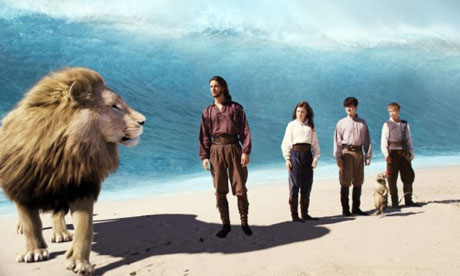
At the end of Prince Caspian it was revealed that Peter and Susan were too old to return to Narnia again. In The Voyage of The Dawn Treader Lucy and Edmund return to Narnia with their not so charming cousin Eustace. The three children end up on the "Dawn Treader", a ship sailing to "The Lone Islands" lead by Caspian.
At the beginning of the story, Eustace is described very negatively, in fact, the first line of the book reads "There was a boy called Eustace Clarence Scrubb, and he almost deserved it." For a good part of the novel, Eustace complains and complains. He does not appreciate Narnia at all and would in fact rather be home in England reading about beetles than going on an epic adventure with kings and talking animals. Lewis includes some journal entries by Eustace in the narrative that consist purely of complaints and criticisms of the journey. Eustace's character first starts to change when he adventures onto an island without either of the children or any of the ship's crew. While describing young Eustace's adventure, Lewis writes: "This showed, by the way, that his new life, little as he suspected it, had already done him some good; the old Eustace, Harold's and Alberta's Eustace, would have given up on that climb after about ten minutes" (pg 65). Here, Lewis directly connects the character improvement in Eustace with his time in Narnia. Shortly after this instance, Eustace stumbled upon a dying dragon. He watched the dragon (who didn't seem to notice him) keel over by a pond. Eustace then climbed into the dragon's den and attempted to take some of the dragon's treasure for himself.
Eustace falls asleep on top of the dragon's treasure and wakes to find himself transformed into a dragon because of the greedy thoughts that he had the night before about all the treasure. At this point in the story, it is clear that Eustace's transformation will end in redemption. Lewis writes "He was a terror himself now and nothing in the world but a knight (and not all of those) would dare to attack him. He could get even with Caspian and Edmund now...But the moment he thought this he realized that he didn't want to. He wanted to be friends. He wanted to get back among humans and talk and laugh and share things. He realized that he was a monster cut off by the whole human race" (pg 77). In his dragon form, Eustace goes through a dramatic transformation. He meets up with the others (still a dragon) and helps them to find food and survive on the island. Eventually, Eustace is returned to his human form and tells Edmund the story of his transformation back to being human. He says that he saw a lion that came towards him at night and motioned for him to follow. The lion brought Eustace to a well and told him to take off his dragon skin. Eustace strips his dragon skin to find another layer of scales, after a few tries, Aslan ripped off the rest of Eustace's dragon skin, returning him to human form. This transformation seems comparable to an understanding of being "saved" in Christianity. After his dragon transformation, Eustace's character changes dramatically, he is friendlier and helpful and all together a more pleasant person, all because of Narnia and Aslan's interference.
Eustace's redemption in The Voyage of the Dawn Treader is possibly the most notable religious occurrence in this story, however Aslan and religion do make other appearances. After leaving Dragon Island, Caspian and the children voyage on to another island that is full of invisible creatures. The creatures ask Lucy to read from a magician's book in order to make them visible again. Lucy agrees and looks through the magician's book to find the spell to make the invisible visible. Before finding that spell, she looks at other spells-and is tempted by a few. She is tempted by a spell that would make her the most beautiful mortal, and almost reads the spell out loud until she notices that the illustrations in the book have changed and now show Aslan glaring back at Lucy. From this sign, she knows that she must not indulge in such magic. After that skipping that spell, she finds a spell that will allow her to know what her friends think of her. Lucy finally finds the spell to make the invisible visible and performs it. After performing this spell, Aslan appears and Lucy tells she was glad he came. Aslan replies "I have been here all the time...but you have just made me visible."(pg 135). This implies that Aslan is always watching over Narnia and the children, even if they can't see him, just as a God would.
At the end of The Voyage of the Dawn Treader the children meet up with Aslan and ask him if they will be able to return to Narnia again. Aslan tell them that they will not, because, like Peter and Susan they have grown too old. This seems to confirm the idea of purity being paired with youth, presented in the previous novel. Aslan goes on to say that he does exist outside of Narnia, in our world. "But there I have another name. You must learn to know me by that name. This is the very reason why you were brought here for a little, you may know me better there." (pg 216). This statement definitely seems to imply that Aslan is the Narnia form of Jesus Christ and the children were brought to Narnia to learn that and return to their normal lives.
This novel has definitely been my favorite so far and was rich in both religion and adventure (and funny little gnome creatures with only one leg and foot). I will read and write about The Silver Chair next.

No comments:
Post a Comment