Monday, January 30, 2012

Narnia and His Dark Materials: A Comparison


This post will cover the similarities and differences (in brief because one could easily write a whole book about it) in The Chronicles of Narnia and His Dark Materials. I will address themes and concepts presented in both series.

Alternate Worlds: Each series exists in a multiverse, one where an abundant (and seemingly limitless) number of worlds exist. This creates an interesting dynamic where the author can create alternate religions, or parallel religions as well as create imaginative creatures and narrative tools.

Children facing hard moral decisions: In both series, children (who are the protagonists in both series as well) are faced with hard decisions and don't really have parental figures (or at least good ones). In both series, the children have to make decisions adults would have to make and play adult roles. For example, Peter and Susan are high king and queen of Narnia and the other children have significant rescue missions that they go on. In His Dark Materials, Will serves as a guardian to his mother and ventures out to find his lost father by himself. He is also given the responsibility of the subtle knife, as Lyra is with the golden compass.


The North: In both series, the concept of "The North" definitely holds significance. In the world that Narnia exists in The North is where Narnia is and the south is where Carolmen is. In both series, the North seems to be where the majority of the magical and religious things occur. I am not sure why both authors choice this concept but it is common in both series.


Talking Animals: There are talking animals in all of the books, which seems like an obvious fantasy concept. In both series, however, not all the animals speak and there is some sort of virtue tied to animals that can speak. In Narnia, it is a crime to kill a talking animal-as they have the same sort of value a human would have, but it is typical and not a crime to kill a normal animal (ie hunting). This is the same in His Dark Materials, of course Daemons are not typical animals but other animals such as talking Mufelas discriminate between them (because they are surrounded by Dust) and the animals they hunt. Animals such as the armored polar bears are also differentiate from other, non-talking animals.

Age and Innocence: In both series, there is a definite connection between age and innocence/purity. In Narnia, there is a certain age at which the children become to old to ever return to Narnia. In His Dark Materials, age is also associated with purity. Lyra can no longer read the golden compass in the pure way that she could before when she reaches purity. Dust is also associated in a way with children that it is not associated with adults. A child's Daemon also settles after puberty.

Heaven, Hell and The Afterlife: The concept of the afterlife is present in both series, although presented differently. In Narnia, the children (excluding Susan) all go to Heaven after being killed in a train crash. Heaven isn't described explicitly in this scene (in The Last Battle), although it is implied that Heaven appears much like Narnia. A Hell isn't explicitly stated either in the Narnia series, although sinners are damned by being reverted to a non-talking animal state. In His Dark Materials, the afterlife is much more explicit, there is a Kingdom of Heaven as where The Authority lives, however this is an alternate world and not a place where most souls go after death. In Pullman's trilogy there is a World of the Dead, which Lyra and Will visit which is a place that all souls go to after death and is controlled by Harpies, a concept from Greek mythology. Lyra is able to make a deal with the Harpies and change how the afterlife functions, something that does not seem likely to ever happen in one of Lewis' books.

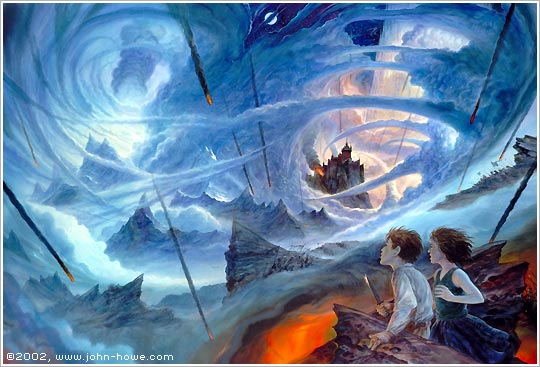
The Amber Spyglass


An update on characters and concepts introduced in the final book of the His Dark Materials trilogy:
Barauch and Balthamos: These two characters are lesser angels that assist Will in finding Lyra. Barauch dies early on in the book. These characters help make it known that there are different ranks/degrees of angels and that some angels were once humans. They are running from the archangel Metatron.

Mulefa: These are the creatures that Dr. Malone meets in an alternate world. They are elephant like but use seedpods that attach to their feet as wheels. The creatures have a complex language and culture and can speak to Malone. The Mulefa have some sort of religious system and a story very similar to the story of Adam and Eve, where a Mulefa without the knowledge of wheels meets a snake who teaches her how to use wheels which in turn created a wise Mulefas.


Dr. Mary Malone (an update): At the end of The Subtle Knife the Dust tells Malone that she must be "the serpent" and she goes on an adventure to try to find Will and Lyra. She meets up with the Mulefa and is accepted into their community. She creates a tool from the sap of the seedpods (that the Mulefa use as their wheels) that allows her to see Dust, this is called the amber spyglass. Malone has also been named the temptress, who will tempt an Eve character (Lyra). Malone does this by telling Lyra the story of why she decided not to become a nun (she fell in love) which "plants a seed in Lyra's mind" and plays the role of the serpent.


The Authority: The Authority was the first Angel to exist and formed Dust. He led other angels and creatures to believe that he was the creator of the multiverse, which led him to claim power in the Kingdom of Heaven. It is said that The Authority goes by many names including "God, the Creator, the Lord, El, Adonai, the King, the Father, the Almighty." (pg 31) He is the God of the Jewish, Christian and Islamic religions and the Bible is his word. The Authority appointed Metatron, the archangel who eventually grows more powerful than the Authority. The Authority ends up trapped in a magical box (essentially) during the final battle. He is released from the box by Lyra and Will and he drifts from the box and dies.

Obviously, there is a lot of religion going on here, to the degree that I thought it would be too difficult to separate the religion from the summary of the book. One thing that I found especially interesting about the religious elements of this book was that God was not the creator and instead was sort of a false God figure. This also reminded me of how Aslan (who was the creator) was impersonated in The Last Battle. Although these events are similar, it is obvious how pro-Christianity Lewis is and how opposite Pullman's views are. When I first started His Dark Materials, I thought that the books were going to much more anti-Catholic (and anti-religious hierarchy) more than anything else, however by killing God and stating that The Authority was the God for all of the Abrahamic religions it was clearly more anti-theistic than I originally thought. Pullman did make it clear that the Authority (God) was not the creator of the multiverse and did not include any information, or even speculation, about how or by whom, the multiverse was created. This is something that I hope he addresses in his next book in the series because it will be really interesting to see if he decides to make a divine creator or a scientific one (or a combination of the two).

Another really interesting religious element in this novel was Lyra's role of Eve. This is also similar to the temptation that was given to Digory in The Magician's Nephew. In Lewis' novel, Digory resists the temptation (which is in the form of a magical fruit) and it would obviously be a sin if he hadn't. However, in The Amber Spyglass, Lyra did give into temptation (love) and it wasn't seen really seen as a bad thing. I interpreted it more as an inevitable, human, thing that happens and not something to be condemned. I speculate that this is also what Pullman is trying to say about Eve being tempted to eat the forbidden fruit; I think he is trying to explain this as a natural progression that Eve was naturally set up to do.

Friday, January 27, 2012

Religion in "The Subtle Knife"


Religious themes definitely start to emerge in this novel and it is clear that Dust plays a big role in religion and the concepts of spirit in the His Dark Materials trilogy. In this novel, Dr. Malone is able to communicate with Dust using a machine she built. The following conversation occurs while using this device:

Malone: The mind that is answering these questions isn't human, is it?
Dust: No. But humans have always known us.
Malone: Us? There's more than one of you?
Dust: Uncountable billions.
Malone: But what are you?
Dust: ANGELS.
Malone: Angels are creatures of shadow matter? of Dust?
Dust: Structures. Complexifications. Yes.
Malone: And shadow matter is what we call spirit?
Dust: From what we are, spirit; From what we do, matter. Matter and spirit are one.
Malone: And did you intervene in human evolution?
Dust: Yes.
Malone: Why?
Dust: Vengeance.
Malone: Vengeance for--oh! Rebel angels! After the war in Heaven--Satan and the Garden of Eden--but it isn't true, is it? Is that what you
Dust: Find the girl and the boy, waste no more time.
Malone: But why?
Dust: You must play the serpent. (pg 220-221)

This conversation is probably the most explicitly religious element in this novel, but is an important one. From this we know that angels are real and that they have a plan for Lyra, Will and Dr. Malone. It is also clear that Dust is integral to human spirit. There statement about Malone being "the serpent" is also incredibly intriguing but it isn't clear what that means yet (it will be expanded on in the next book). The existence of angels in this book is also very intriguing. It is not quite clear what the role of angels in this story will be, although it is clear that they will play a strong role in the next book. The angels that we have met in this novel seem nice enough, but not pure or nurturing. Instead, they seem sort of cold and blunt, which again, is something I think Pullman will expand on in the next book.

Another thing, that will be clearer in the last book (Pullman is really just using this novel and the previous one to set the stage for The Amber Spyglass), is who "the Creator" and why the angels and Lord Asriel seek to destroy it. I have been assuming that the Creator is God, or a God-like being that exists in a physical form (he is able to be killed with the subtle knife). Pullman has just given us glimpses of details about the Creator and angels so far and it will definitely be interesting to see that expanded on in the next novel (which has so much religion in it).

The last thing that I found really interesting in this novel, and the previous novel, is how Pullman juxtaposes science and religion. When I started the first novel in the series I was sure that the Church was against scientific research and that was one of the arguments that Pullman was making against the Church. Instead, it seems like religion and science are really tied together. For example, in the conversation with Dust and Malone, it is clear that evolution exists but there was divine intervention in that evolution. Scientific advances, such as the machine that can converse with Dark Matter/Dust and the golden compass are also the only things that allow humans to communicate with angels and the divine. I was surprised by this because science and religion are often placed at separate ends of the field, especially by anti-theists such as Pullman.

A Brief Introduction the "The Subtle Knife"


This post will cover the aspects of The Subtle Knife that need explaining in order to avoid a huge summary post.


Will: Will is one of the main characters in this novel. He is 12 years old and is from our world. His father disappeared while exploring in the North and his mother seems to be schizophrenic. He is the care giver for his mother, although he leaves her with his old piano teacher when he searches for answers about his father at the beginning of the book. Later in the book he becomes the bearer of the subtle knife. Because he is from our world he has no external daemon. Will travels with Lyra throughout the novel and they become friends.

Dust: More information is given about Dust in this novel. It is revealed that in our world, Dust is also studied, but in the form of studies on Dark Matter. Dust is conscious and can communicate with humans if the right tools are used. Dr. Malone has created a device (that Lyra perfects) that allows a human to communicate with Dust. As suggested in the previous novel, Dust clearly has a religious significance and plays a role in one's spirit.


Specters: Specters are creatures that exist in an alternate world that Lyra and Will travel through. Specters seem to feed on the human spirit, but only feed on adults. They are able to fly and have taken the spirits of the majority of the adults in this world. They are said to have appeared in the last few hundred years, as a result of humans using the subtle knife, a device that can cut through worlds. The specter infestation in this world is also said to have gotten worse right after Lyra's father bridged the worlds and opened up a door from his world to other worlds. It is not clear what

Angels: Angels appear to the witches and several other characters in the novel, flying in the sky. Their physical forms are tall, naked and human like-but with wings. They are connected with Dust-it seems that they might even be Dust, although it is not clear (yet). They are assisting Lord Asriel with his task, which is killing the Creator. We do not know much about this task either or why the Angels wish to destroy the Creator.

Dr. Mary Malone: This character is the scholar that Lyra goes to in our world, at Oxford. She is a scientist (who is a former nun) that is investigating Dark Matter. It is clear that she is important and will play a role in the final novel, although it isn't clear what that role will be. She is the scientist that has developed a device that allows communication with Dust.

Sir Charles Latrom: This character is a man from Lyra's world that exists in our world. He is friends with Mrs. Coulter and is seeking the subtle knife. He attempts to force Lyra and Will to retrieve the knife for him by stealing Lyra's golden compass and demanding the knife in trade. Lyra and will do end up retrieving the knife but are able to steal the golden compass back and now have both tools in their possession.

The Subtle Knife: This knife is a device that can create doors to other worlds. It is not quite clear what the back story is behind the knife, however it is clear that the knife is the reason that the specters came into one of the worlds. This knife is also the only object that can be used to kill the Creator. There can only be one bearer of the knife at a time, it is currently Will who had to fight for it and lost two fingers (all bearers of the knife loose these two fingers while trying to get the knife).

Alternate Worlds: There seem to be countless worlds in this universe. They can be traveled to by using the knife or flying through doors high in the sky (how the Angels travel). The worlds we have seen so far are our world (the one that Will is from), Lyra's world and the world with the specters.

Dr. Grumman/The Shaman: Dr. Grumman is Will's father. He got trapped in Lyra's world 11 years prior to this story while on an expedition in the North. He is killed at the end of this novel, just after being reunited with Will.

Wednesday, January 25, 2012

Religion in The Golden Compass


Note:
The Golden Compass is a long book, with complex elements. It will be helpful to read my prior post explaining the characters in the novel and the universe that the novel takes place in.

The primary religion in The Golden Compass (and the only one mentioned) in Christianity, specifically Catholicism. Pullman is very overt with this and mentions Christianity, the Papacy and the Vatican by name in his novels (something that Lewis did not do in The Chronicles of Narnia). The Christian Bible is also mentioned and even quoted in the novel. The Catholic Church in the book is referred to as "The Church" and "The Magisterium" which also seems to have some sort of governmental authority.


Theology as an academic profession is also emphasized as that is what Lord Asriel and the other scholars mentioned in the novel are involved in. Theolog
y and "Experimental Theology" however, seem to be more like the study of physics and other sciences than what we think of when we think "theology".

Another thing that is brought up in the book is heresy. Lord Asriel is working on theories about Dust, a concept that we don't know much about in the first book, but it is clear that his work is controversial and is condemned by the Church. Asriel is even imprisoned for his work. It is not clear exactly what Asriel is doing and why what he is doing is controversial. On page 274, Lyra overhears people saying the following: "I think he has got an entirely different idea of the nature of Dust, that's the point. It's profoundly heretical, you see, and the Consistorial Court of Discipline can't allow any other interpretation than the authorized one." This statement definitely implies that the Church has certain ideas that they promote and that they don't want people deviating from those concepts. Not much else is said about what ideas the Church holds until they very end of the first novel, when Lyra discusses Dust with her father in the North.

Until the very end of the first novel, we don't know much about Dust, eventually it is revealed that Dust has a very religious and theological significance. Lyra's father explains Dust by using the story of Adam and Eve and the forbidden fruit. Here, he says that Dust stems from Original Sin. He later reveals that he wants to go to the source of Dust and destroy it, in turn, destroying the source of sin and death (pg 377). If he succeeded, it is clear that this would be extremely heretical and even destroy the Church. The idea of destroying the source of Dust definitely develops in the next two novels and it will become clear who supports it and who does not which creates a lot of religious tension.


Tuesday, January 24, 2012

His Dark Materials: An Introduction


In order to help explain The Golden Compass and the His Dark Materials trilogy, I will be providing summaries and explanations of the basics to the universe presented in the trilogy. These summaries and explanations are aimed to help explain the complex 400 page novels without having to summarize each novel as I explain the religious elements.


Author and Publication:

The trilogy was written by the English writer Phillip Pullman and consists of The Golden Compass (also known as The Northern Lights in the UK), The Subtle Knife and The Amber Spyglass, published in 1995, 1997 and 2000, respectively. The titles of the novels (exluding the British "Northern Lights") are all names of tools/objects that are important to each novel. Pullman is known as being an "outspoken atheist" and has commented extensively about the Catholic Church. Pullman is in the process of writing and publishing The Book of Dust which will be a companion novel to the His Dark Materials trilogy.

Characters and Universe

Setting: The world that the first novel is based in is very similar to the world we live in. Most, but not all, of the countries mentioned in the novel are real countries. Things like the bank Wells Fargo are also mentioned. Zeppelins are a common form of transportation in this world.

Lyra: Lyra is the protagonist of the trilogy. Her age is not yet specified although it is clear that she has not yet hit puberty, she is probably around eleven years old at the beginning of the trilogy. She was raised in a theology college within Oxford called Jordan College. She was taught by scholars and raised by a man who she thought was her uncle but later (about halfway into the first novel) finds out that he is her birth father. Lyria's daemon is named Pantalaimon (nicknamed Pan) and has not yet settled into an animal since Lyria is still a child. Lyria is very brave, outspoken as well as spunky and playful. Although Pan has not yet settled he often appears as a mouse, a wildcat, a moth and an ermine. Witches have prophesied that Lyria will be instrumental in keeping the balance of life but is not aware of her destiny. She is unique in being able to read an alethiometer.

Daemons:
In Lyria's universe, each human is born with a daemon which is a manifestation of the soul that exists outside the human's body. Daemons appear in animal form which is fluid before the human reaches puberty but settles to a specific animal after puberty. The animal that one's daemon settles into reflects the person's personality. If a person's daemon is killed, the individual is also killed; the individual can also feel any physical pain that their daemon feels. An individual can only be at most several meters away from their daemon at any given time (unless the individual is a witch). Daemons can talk to humans but often only speak to their own individual.


Alethiometer: An alethiometer, or a "Golden Compass" is a device that can answer any question you ask it, truthfully. Lyra can read the alethiometer, which is a skill that is unique to her. Only a few alethiometers were ever made and it is said that the Church destroyed most of them. The alethiometer is powered by Dust.

Dust: We do not know very much about Dust (yet). However, it is revealed in the first novel that Dust is an elementary particle and has something to do with "Original Sin". It is believed that Dust originates in an alternate universe. The North and the Northern Lights seem to be connected to Dust.

Lord Asriel: Lord Asriel is Lyra's birth father but raised her as his niece. Lyra was told that her parents had died in an accident and was raised in Jordan College where Lord Asriel worked, although he was often not present. Asriel is a scientist and explorer who is interested in Dust. In The Golden Compass he spends most of the novel imprisoned in the North. He is a morally grey character, especially due to his act of betrayal to Lyra at the very end of the novel. Lord Asriel is trying to destroy the source of Dust.


Panserbjørn: These are armored polar bears who live in the North and fight for whoever they are contracted to. Lyra befriends one of these halfway through The Golden Compass, named Iorek Byrnison. He ultimately becomes king of the armored polar bears (at the end of the first novel).


Mrs. Maria Coulter: Mrs. Coulter is Lyra's birth mother although Lyra did not meet her until she was eleven (during the novel). Coulter is in charge of the Gobblers and often kidnaps the children herself. Lyra traveled with Coulter at the beginning of the book (not knowing that she was her mother) and ran away when she found out that Coulter was involved with the kidnapping of children.


Witches: As of the first novel, not a ton is explained about the witches. Although we do know that they are another race, different from humans although they resemble humans. Witches are only females (they can reproduce with human males) and live for hundreds of years. They live in the wild and are able to fly and have few possessions. Witches assist Lyra in her journey in the first novel. Witches have daemons but they are able to be hundreds of miles away from them.


Gypians: The Gypians are a group of humans who live like Gypsies and are traders that travel on boats. A group of Gypians assist Lyra greatly in the novel, saving her life multiple times. The Gypians are poor and their children were the ones that were kidnapped the most by the General Oblation Board, or the Gobblers. The leader of the Gypians is John Faa.

Roger: Roger is Lyra's best friend, he works in the kitchen at Jordan College. Roger was kidnapped by the Gobblers and Lyra set out to rescue him. He is killed by Lord Asriel at the end of the first novel when Asriel betrays Lyra and uses Roger to create a bridge to another universe.

The Master: The Master is the head of Jordan College and gave Lyra the golden compass. He is very concerned with protecting Lyra. He tried to poison Lord Asriel in the very beginning of the book, however, it does seem like that he is a virtuous character in the trilogy.

The Gobblers: The Gobblers or The General Oblation Board is an organization, funded by the Church, that kidnaps children (most often children of poor families) and experiments on them. They are experimenting with a process called intercision that cuts a child's daemon away from their being. It seems as though all of their attempts to do this eventually lead to the child's death. Lyra and others regard the idea of separating a daemon from an individual as a unimaginably horrible thing. Lyra meets a boy (shortly before he dies) that had been surgically separated from his daemon and the boy was incredibly lost and confused, almost like he was a ghost.


Monday, January 23, 2012

Movies!

Some movie trailer fun, below are the trailers for the Narnia movies and the Golden Compass movie. It might be especially helpful to watch the Golden Compass one because it is helpful in understanding the world that Pullman presents.